
As can be seen from our previous blog on the blood brain barrier, new technologies and shuttles are providing even more ways to deliver CNS treatments into the brain. But there remains a critical reality – crossing the BBB is only half the battle.
Once a drug breaches the BBB and enters the brain’s interstitial fluid it must still find and penetrate specific diseased cells and be present in meaningful concentrations.
Traditional shuttles, or transport vehicles, have employed transferrin receptor 1 (TfR) to transport treatments the brain. But while TfR is effective at crossing the BBB it has a limited therapeutic window.
One potential solution to this problem is dual targeting. This approach treats drug delivery as a two-step relay race, utilizing two distinct biological transport systems in tandem.
Two Shuttles Better Than One
Pre-clinical research by (Wells, Robert C. et al)1 has looked at combining TfR and another protein highly expressed at the BBB – CD98hc, a heavy chain amino acid transporter.
Pairing the two plays to their various strengths. TfR is associated with rapid uptake in the brain at high concentrations. But this rapid transport can also drive rapid clearance, as TfR-targeting molecules often localize to neurons, where they are internalized and degraded.
In contrast, CD98hc molecules enter the brain more slowly and once there tend to remain longer, leading to significantly higher overall brain concentrations. CD98hc-binding drugs are also often retained near astrocytes and other non-neuronal compartments and show less rapid intracellular degradation.
So, combining the two into a “dual transport vehicle” (dual TV) should allow relatively rapid entry into the brain coupled with prolonged retention.
Double The Power
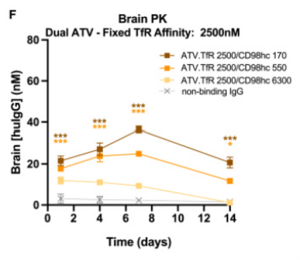
Wells et al’s study appears to confirm this, showing that dual targeting produced significantly higher brain exposure in humanized mouse models than targeting either TfR or CD98hc alone.
In some configurations of their study, peak brain concentrations and overall exposure of a dual TV with moderate TfR affinity and strong CD98hc affinity were more than double those achieved with single-receptor transport vehicles.
The researchers also found that reducing TfR affinity while maintaining strong CD98hc affinity produced sustained brain concentrations of the dual TV for up to two weeks in mouse brain models, something not previously achieved with either TfR or CD98hc alone at comparable doses.
This finding demonstrates the versatility of the dual-targeting approach. By adjusting how tightly the molecule binds to each receptor – the binding affinity – researchers could adjust both the magnitude and duration of brain exposure.
Stronger TfR binding accelerated initial uptake, while stronger CD98hc binding prolonged brain retention. By balancing these affinities, drug developers could design exposure profiles tailored to specific therapeutic needs.
Multiple Uses
According to Jacinthe Gingras of Stealth Biotech dual targeting can also be used in a variety of ways. Like single transport vehicles, therapeutic molecules like antibodies, can be linked to dual TVs. Once the dual TV and payload cross the BBB the same receptors TfR1 and/or CD98hc are leveraged allow the therapy to get into brain cells.
Dual TVs can also be deployed to target binding sites uniquely expressed on CD89hc or TfR1 and the diseased brain cell type of interest. This would allow the payload to cross the BBB and then be directed more precisely – and ideally exclusively – to cells expressing the second specific target against which an individual antibody binds, or epitope. This second epitope could include neurons, oligodendrocytes or microglia.
Additionally, when it comes to delivering gene therapies to enhance the BBB crossing of an adeno associated virus (AAV), they can also be linked to another transporter – similar to the combining of TfR and CD98hc. Adding TfR or CD98hc to an AAV is thought to further increase AAV entry without having to increase the viral dose.
Although it might be tempting to add an AAV to a dual TV and a payload for even more potent therapies, this could be counterproductive with additional complexity potentially leading to more off-target effects warns Gingras. “While ‘more is more’ can be an attractive approach, sometimes more gets to be ‘too much’, and keeping things simple gets you to the finish line faster and safer.”
Conclusion
The broad significance of dual targeting lies in its potential flexibility and durability as many CNS treatments have failed due to their inability to get insufficient drug into the brain. A dual transport delivery system that could enhance and fine tune exposure – as well as paring with antibodies or gene therapy payloads could open the door to a host of new CNS therapeutic approaches.
However, it should be remembered that dual targeting is still in its infancy. To date outside of academia, Denali is one of the few companies that have published research. As such, more clinical studies are needed, along with further validation in higher species.
But, if they are successful dual TVs represent a unique and significant advance in brain delivery strategies – moving from a ‘crossing or not crossing’ model, to more precise, programmable systems, a shift that could be transformational.
- Dual targeting of transferrin receptor and CD98hc enhances brain exposure of large molecules
Wells, Robert C. et al. – Cell Reports, Volume 44, Issue 8, 116038
Related Resources
Check out Neuroscience related resources available from Beacon.

Learn More About Neuroscience
- The Most Comprehensive Way to Search the Neuroscience Drug Development Landscape: Unique search ontologies based on Neuroscience drug and trial characteristics
- Market Leading Approach to Neuroscience Preclinical & Clinical Data Curation: Manual curation of key Neuroscience research and development data points by Neuroscience research scientists
- Seamlessly Integrate Commercial & Scientific Data all in One Place: Search Neuroscience company and deal data based on their pipeline and technologies.
- Unrivalled Granularity in Reports & Analysis: Our search ontology and technology indexing enable comprehensive analysis not seen elsewhere.
What is Beacon?
Beacon is a world leading data analysis tool for preclinical and clinical trial information. With unrivalled granularity of search function, data quality, and exhaustiveness, Beacon provides timely information and gives you confidence to progress your targeted drug therapies to patients.
Learn more about how our clinical trials and drug database solutions can be tailored to your research requirements