
For decades the inability to cross the blood brain barrier (BBB) has been the graveyard of scores of promising treatments for central nervous system (CNS) disorders like Alzheimer’s, Parkinson’s and ALS.
This is because the BBB effectively blocks 98% of small-molecule drugs and almost 100% of large-molecule biologic drugs, like antibodies, from entering the brain (Wu et al, 2023).
However, the tide is turning. Alongside groups in late-stage clinical trials like Switzerland’s Roche and San Francisco’s Denali Therapeutics, a new wave of smaller companies are developing new technology to create drugs that could cross the BBB and revolutionize the treatment of Alzheimer’s and other CNS disorders.
Getting Closer to Market
Both Roche and Denali utilize receptor mediated transcytosis, the most commercially pursued mechanism or “shuttle” for getting therapies into the brain. Roche’s propriety BrainshuttleTM has been deployed in the group’s Alzheimer’s drug, trontinemab. While Denali’s, DNL310, (Tividenofusp alfa) for Hunter Syndrome uses the group’s modular TransportVehicle™ (TV) technology. Unlike BrainshuttleTM, TV can deliver not just antibodies (ATV) but enzymes (ETV), oligonucleotides (OTV) and proteins (PTV) across the BBB.
Trontinemab is currently in phase 3 trials, while tividenofusp is fast approaching commercial approval with an FDA decision due by April 5. Marketing authorization would make DNL310 the first broadly commercialized RMT biologic in the west, following the approval of JCR Pharmaceuticals’ Hunter Syndrome treatment Izcargo (pabinafusp alpha) in Japan in 2021.
The New Wave
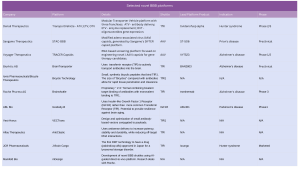
While companies like Denali, Roche and JCR Pharmaceuticals represent some of the most advanced companies operating in the RMT space, a new generation of biotechs are hot on their heels. These challengers offer both differentiated technology platforms and drug cargos.
Rather than traditional large antibodies, Vect-Horus is leveraging its proprietary VECTrans platform to develop engineered peptide vectors attached to antibody fragment targets known as VHHs to shuttle payloads across the BBB. Derived from heavy chain-only camelid (llama/camel) antibodies VHHs have the advantage of high
stability, while their small size enables deep tissue penetration. The group’s therapeutic payloads include oligonucleotides and proteins. ABL Bio’s Grabody-B platform has also distinguished itself in the crowded BBB field by targeting the insulin-like growth factor 1 receptor (IGF1R), rather than the more commonly targeted transferrin receptor (TfR).
This strategic choice of receptor offers unique biological merits, particularly for treating age-related neurodegenerative diseases. Traditional TfR-based shuttles rely on the transferrin receptor, whose expression levels can decrease significantly as the brain ages.
In contrast, IGF1R expression remains relatively stable on brain endothelial cells even in older brains. In preclinical mouse trials data has suggested that Grabody-B maintains comparable brain penetration in both young and old mice, theoretically making it more suitable for geriatric populations. ABL’s lead candidate, ABL301 a bispecific antibody targeting alpha-synuclein partnered with Sanofi, is in phase 1 for Parkinson’s.
Anti Traditional Antibody
While ABL Bio is exploring IGF1R, companies like Voyager Therapeutics and Sangamo Therapeutics are leading the gene therapy drive in RMT, delivering genetic medicines through adeno-associated virus (AAV) capsids.
Voyager’s Tracer Capsids platform has used RNA-based screening to develop capsids that bind to novel receptors like alkaline phosphatase (ALPL) rather than just TfR. Voyager has claimed this technology has not only increased better CNS transduction but helped avoid some of the liver toxicity risks that have plagued early gene therapies.
In contrast, Sangamo’s STACC-BBB platform is focused on engineering high potency capsids to increase transgene expression compared with standard AAV9. This could allow for ultra-low dosing, potentially minimizing the immune response risks associated with high viral loads. Other groups also looking beyond antibody delivery include Ionis Therapeutics and Bicycle Therapeutics and Alloy Therapeutics.
Ionis and Bicycle Therapeutics’ Bicycle Technology platform is differentiated by the size of its drug payload. Instead of large antibodies or viruses, Bicycle uses small, synthetic bicyclic peptides that bind TfR1. These tiny “Bicycles” are conjugated to Ionis’s antisense oligonucleotides, allowing for rapid tissue penetration and clearance, according to the groups.
Also riding the antisense BBB train is Alloy Therapeutics with its AntiClastic Antisense platform, which the company claims is overcoming some of the safety and potency
limitations of current antisense therapies by reaching intracellular targets at the RNA level.
Big Pharma Interest
The innovative ways smaller companies are finding to cross the BBB has not gone unnoticed by large pharma groups. Increased competition in CNS space, particularly dementia, is driving more big pharma groups to either licensing or buy new BBB technology One of the biggest examples of this trend was AbbVie’s $1.4bn purchase of Aliada Therapeutics in October 2024. While many looking at the deal focused on Aliada’s phase I lead product, ALIA-1758, for Alzheimer’s disease, the real prize was Aliada’s BBB crossing Modular Delivery (MODELTM) platform. CNS big hitter Eli Lilly has also invested heavily in in-licensing BBB platform technology, striking two major deals worth up to $4bn in eight months. In April 2025, the group announced a licensing pact worth up to $1.4bn with Sangamo to develop up to five potential disease targets using the California-based group’s STAC-BBB, adeno-associated virus (AAV) capsid platform. Then in November Lilly inked a potential $2.6bn deal with Korea’s ABL Bio to gain access to its Grabody-B bi-specific antibody shuttle technology.
Eisai is also seeking to improve the delivery of its CNS drugs, with partner Bioartic. Following their successful joint commercialization deal in 2014 for Alzheimer’s drug Leqembi, Eisai announced in 2024 it was entering into a research agreement with Bioartic for BN2802, an Alzheimer’s drug candidate that will use Bioartic’s proprietary BrainTransporterTM technology.
Playing Catch Up
Outside of the big pharma groups with approved CNS products, others in the space who have either previously scaled back neuroscience research, or fallen behind in the race for first generation Alzheimer’s drugs, are striking BBB platform deals in hope of developing more effective second-generation dementia drugs.
Alongside Lilly, Bioartic has also signed BrainTransporterTM license agreements with Bristol Myers Squibb and more recently with Novartis, both of whom have lagged in getting new dementia products to market. Novartis’s seriousness in bolstering its BBB CNS pipeline, has been further demonstrated by the $1.7bn deal it struck with SciNeuro in January for its shuttle technology, which included an impressive $165m upfront payment. GSK, which is also playing catch up, is pinning its BBB hopes on ABL Bio’s Grabody-B platform. Last April, the UK pharma group signed a $2.5bn bio dollar deal to develop
‘multiple programs’ targeting IGF1R, a decision that could differentiate it from BBB companies using TfR. While Sanofi has provided validation to Alloy Therapeutics’ AntiClastic Antisense BBB platform with a $27.5m upfront licensing deal to develop an antisense CNS candidate.
But it is not just companies without home-grown BBB shuttle technologies that are looking at ways to gain a bigger foothold in the dementia space. Last November, Roche struck a $55m upfront deal with small BBB company Manifold Bio that could balloon to $2bn if clinical and sales milestones are met.
Roche’s interest was piqued by Manifold’s mDesign platform, which leverages large-scale in vivo data generation to power AI models that create a drug design engine which learns directly from living systems. Roche will be hoping the ability to create multiple potential shuttles will augment its own BrainshuttleTM platform.
Conclusion
The emergence of agile innovators with BBB new platform technologies is shaking up drug development for CNS disorders, as companies move closer to market with large molecule products that can now cross into the once impenetrable fortress of the brain.
While the ability of newer players in the BBB space to secure billion-dollar licensing agreements points to a fundamental change in CNS drug development, with pharma groups viewing BBB-crossing technology a ‘must have’ rather than an option for success.
This paradigm shift could begin to transform CNS drug development from a field of frequent failures into one of targeted, life-changing breakthroughs.
Looking for more? Read the second blog in this series here.
Related Resources
Check out Neuroscience related resources available from Beacon.
Learn More About Neuroscience
- The Most Comprehensive Way to Search the Neuroscience Drug Development Landscape: Unique search ontologies based on Neuroscience drug and trial characteristics
- Market Leading Approach to Neuroscience Preclinical & Clinical Data Curation: Manual curation of key Neuroscience research and development data points by Neuroscience research scientists
- Seamlessly Integrate Commercial & Scientific Data all in One Place: Search Neuroscience company and deal data based on their pipeline and technologies.
- Unrivalled Granularity in Reports & Analysis: Our search ontology and technology indexing enable comprehensive analysis not seen elsewhere.
What is Beacon?
Beacon is a world leading data analysis tool for preclinical and clinical trial information. With unrivalled granularity of search function, data quality, and exhaustiveness, Beacon provides timely information and gives you confidence to progress your targeted drug therapies to patients.
Learn more about how our clinical trials and drug database solutions can be tailored to your research requirements